

1.Abstract
The latest advances of diffusion models in biomolecular structure prediction are still based on distance-based supervised training without adequately accounting for physically plausible interactions needed for real-world drug discovery. We introduce 𝝅-Fold, a novel physics-informed policy-based folding approach that augments reinforcement learning with physics-aware scoring functions for training biomolecular diffusion models. Specifically, we fine-tune co-folding models using Group Relative Policy Optimization and explicit physics-based rewards such as Rosetta all-atom energy, AutoDock Vina binding affinity, and ligand strain energy. Crucially, we demonstrate that these physics-based priors translate to enhanced performance on critical downstream prediction tasks. 𝝅-Fold achieves state-of-the-art results on SKEMPI for protein–protein mutation effects, CASP16 and OpenFE for protein–ligand binding affinities, Run-N-Poses for ligand geometric validity and interface quality across diverse structural fidelity metrics. On FoldBench, 𝝅-Fold achieves the best overall MolProbity score of 1.34, halving steric clashes and nearly eliminating rotamer outliers. Human evaluation further confirms that 𝝅-Fold generates structures that are meaningful for downstream drug discovery applications.
2.TL;DR
We propose 𝝅-Fold, a Physics-Informed policy-based approach that fine-tunes biomolecular co-folding models directly with physics-based rewards.
- 𝝅-Fold achieves the best MolProbity score on FoldBench (1.34), outperforming AlphaFold3 (1.54) and more than halving steric clashes relative to its base model.
- 𝝅-Fold structures correlate better with experimental measurements than any other structure-based method: mutation effects on SKEMPI (n ≈ 210), binding affinity on CASP16 (n = 140) and OpenFE (n = 873).
- 𝝅-Fold yields up to 68% PoseBusters-valid ligands and over 94% clash-free complexes, while preserving the global fold of the base model.
- 𝝅-Fold outperforms both supervised fine-tuning on relaxed data and inference-time physics steering, halving the clashscore of Boltz2x.
𝝅-Fold shows that reinforcement learning can amortize physical priors directly into diffusion model weights, bridging data-driven structure prediction and physics-based molecular modeling.
3.Method
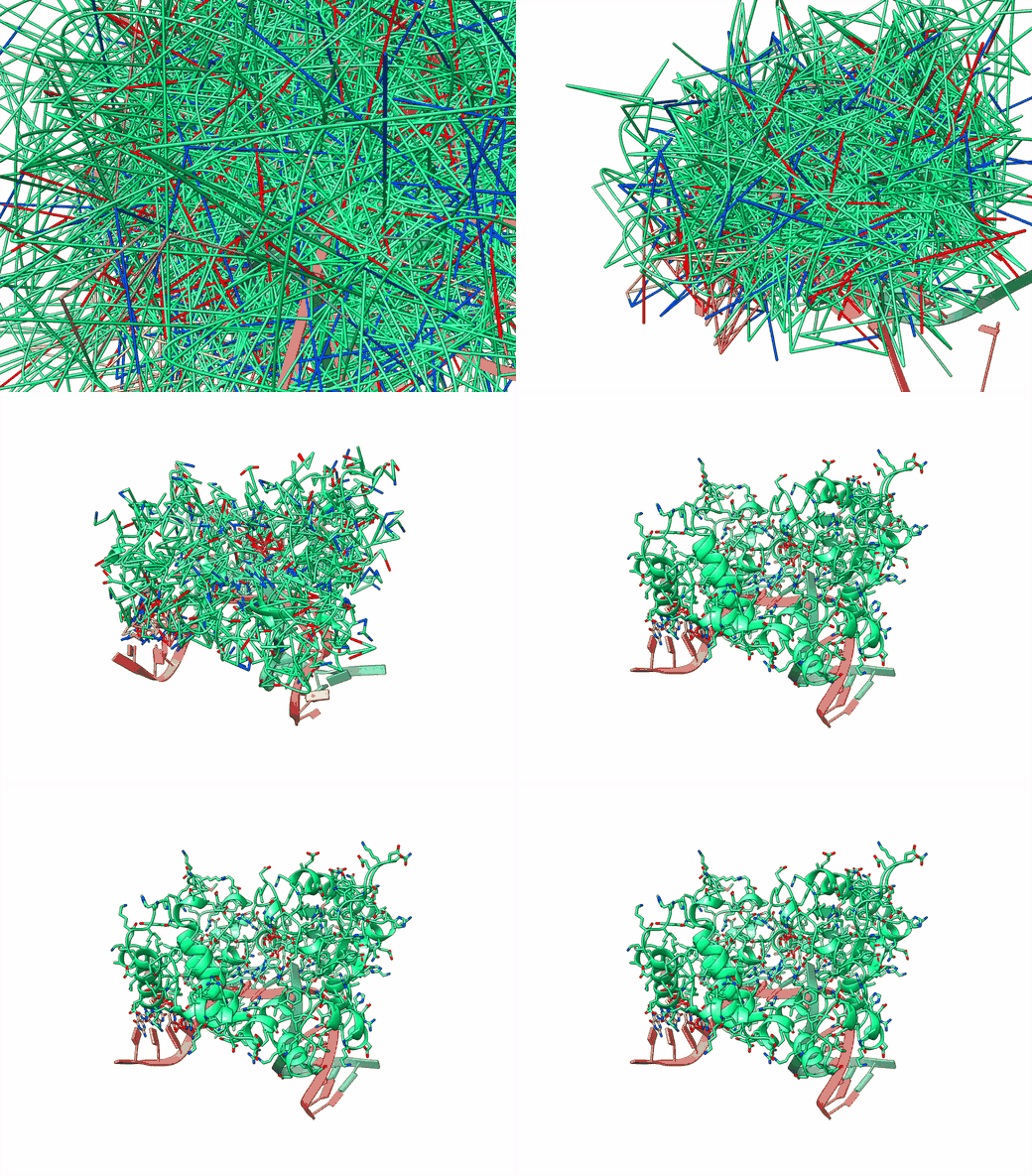
Reverse diffusion in 𝝅-Fold. A cloud of atoms resolving into a folded complex.
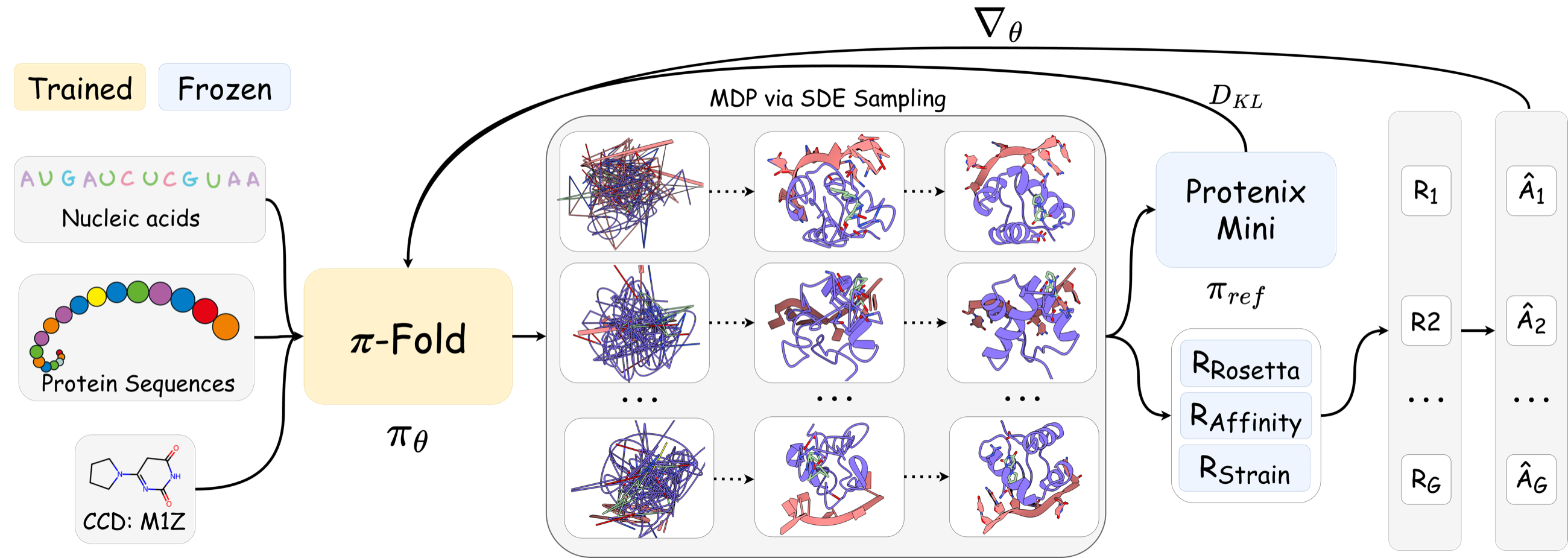
𝝅-Fold fine-tunes the diffusion module of a co-folding model with online reinforcement learning. Starting from Protenix Mini (130M), reverse diffusion becomes a Markov decision process: the denoiser is the policy, a denoising step is an action, and training samples trajectories through a reverse-time SDE. Group Relative Policy Optimization (GRPO) rolls out G = 24 candidate structures per input, scores each finished structure with the composite physics reward, and normalizes that score against the group's own mean, so no value network is needed. Only the diffusion module is updated; the Pairformer trunk stays frozen and a KL penalty keeps the update close to the reference policy.
Reward Design
Structure reward. The Rosetta beta_jan25 energy, normalized per residue so it doesn't scale with complex size, then clipped and min-max scaled to :
Ligand rewards. Vina affinity rewards tight binding, while RDKit UFF strain energy penalizes distorted ligands that would otherwise hack the affinity score:
Final reward. A weighted combination of all three, with , , and :
4.Results
Structural quality on FoldBench
Stereochemical quality across FoldBench, measured with MolProbity on the predicted coordinates. Lower is better on both panels.
Structural quality on FoldBench. 𝝅-Fold achieves the best MolProbity (1.341) and rotamer outlier rate (0.065), cutting clashscore from 16.77 to 6.46 relative to its base model.
Ligand interfaces
Interface quality on both benchmarks: PoseBusters validity, the share with no steric clash, and Uni-GBSA binding free energy. The experimental structure is a reference here, not a competitor.
| Model | PB-valid | Clash-free | MM/GBSA |
|---|---|---|---|
| 𝝅-Fold | 67.00 | 93.33 | -41.20 |
| AlphaFold3 | 64.38 | 84.68 | -34.72 |
| Protenix v1 | 63.11 | 83.68 | -36.32 |
| Protenix Mini | 61.29 | 86.19 | -39.17 |
| Boltz-1 | 50.22 | 79.26 | -32.62 |
| Experimental | 67.14 | 91.24 | -40.50 |
| Model | PB-valid | Clash-free | MM/GBSA |
|---|---|---|---|
| 𝝅-Fold | 68.75 | 94.28 | -49.56 |
| AlphaFold3 | 66.24 | 84.22 | -38.93 |
| Protenix v1 | 63.37 | 85.97 | -43.34 |
| Protenix Mini | 66.24 | 88.71 | -46.79 |
| Boltz-1 | 51.60 | 77.05 | -42.53 |
| Experimental | 77.54 | 90.98 | -48.76 |
Ligand interface quality on FoldBench and Run-N-Poses. 𝝅-Fold yields up to 68% PoseBusters-valid ligands, over 94% clash-free complexes, and the strongest MM/GBSA binding energies.
Mutation effects and binding affinity
Pearson correlation with experiment, scored on the predicted coordinates without relaxation. Boltz-2 is hatched because it reads affinity off its own confidence head rather than the geometry it generates.
Performance on mutation effect and binding affinity benchmarks. Among methods judged purely on the biophysical quality of the 3D structures they generate, 𝝅-Fold correlates best with experiment on all three: 0.631 on SKEMPI, 0.558 on OpenFE and 0.468 on CASP16, against 0.356 for its Protenix Mini initialization and 0.254 for AlphaFold3 on CASP16.
RL vs. inference-time steering
Boltz2x applies physical potentials while sampling instead of training them in. The zero-shot comparison uses the FoldBench subset deposited after Boltz2's cutoff (n = 784).
Training-time RL vs. inference-time steering. On FoldBench structures released after Boltz2's training cutoff, 𝝅-Fold halves the clashscore of Boltz2x (5.34 vs. 10.69) and nearly eliminates rotamer outliers.
Human evaluation
Two medicinal chemists reviewed 30 cases from FoldBench and Run-N-Poses independently, then reconciled their judgments. More than one model can win a given case, so the rates do not sum to 100%.
| Model | Wins | Win rate |
|---|---|---|
| 𝝅-Fold | 18/30 | 60.0% |
| AlphaFold3 | 14/30 | 46.6% |
| Protenix v1 | 12/30 | 40.0% |
Human evaluation by medicinal chemists on 30 challenging cases. 𝝅-Fold is preferred in 60% of cases, compared with 46.6% for AlphaFold3 and 40% for Protenix-v1.
Finds the allosteric site both baselines miss. 𝝅-Fold correctly predicted the allosteric binding site and retrieved the interacting residues (F230, Y227), failing only on the precise orientation of the ligand. AF3 and Protenix v1 predicted the wrong binding site and retrieved few or no physical interactions.
Citation
@inproceedings{dang2026pifold,
  title={Plausible Biomolecular Structure Prediction via Physics-informed Reinforcement Learning},
  author={Dang, Tai and Tran, Hieu and Pham, Long-Hung and Truong, Sang T. and Pham, Edward A. and Glenn, Jeffrey S. and Luong, Thang},
  booktitle={Advances in Neural Information Processing Systems (NeurIPS)},
  year={2026}
}